
AI isn't replacing people. It's revealing their strengths.
24 Jun 2026
AI didn’t make them better. It stopped getting in the way.
The conversation about AI and the workforce is almost entirely about replacement. Which roles are at risk. What gets automated. Who’s left.
That’s not what I’m seeing inside the organisations actually using it well.
What I’m seeing is different: AI doesn’t replace people’s strengths. It removes the things getting in the way of them.
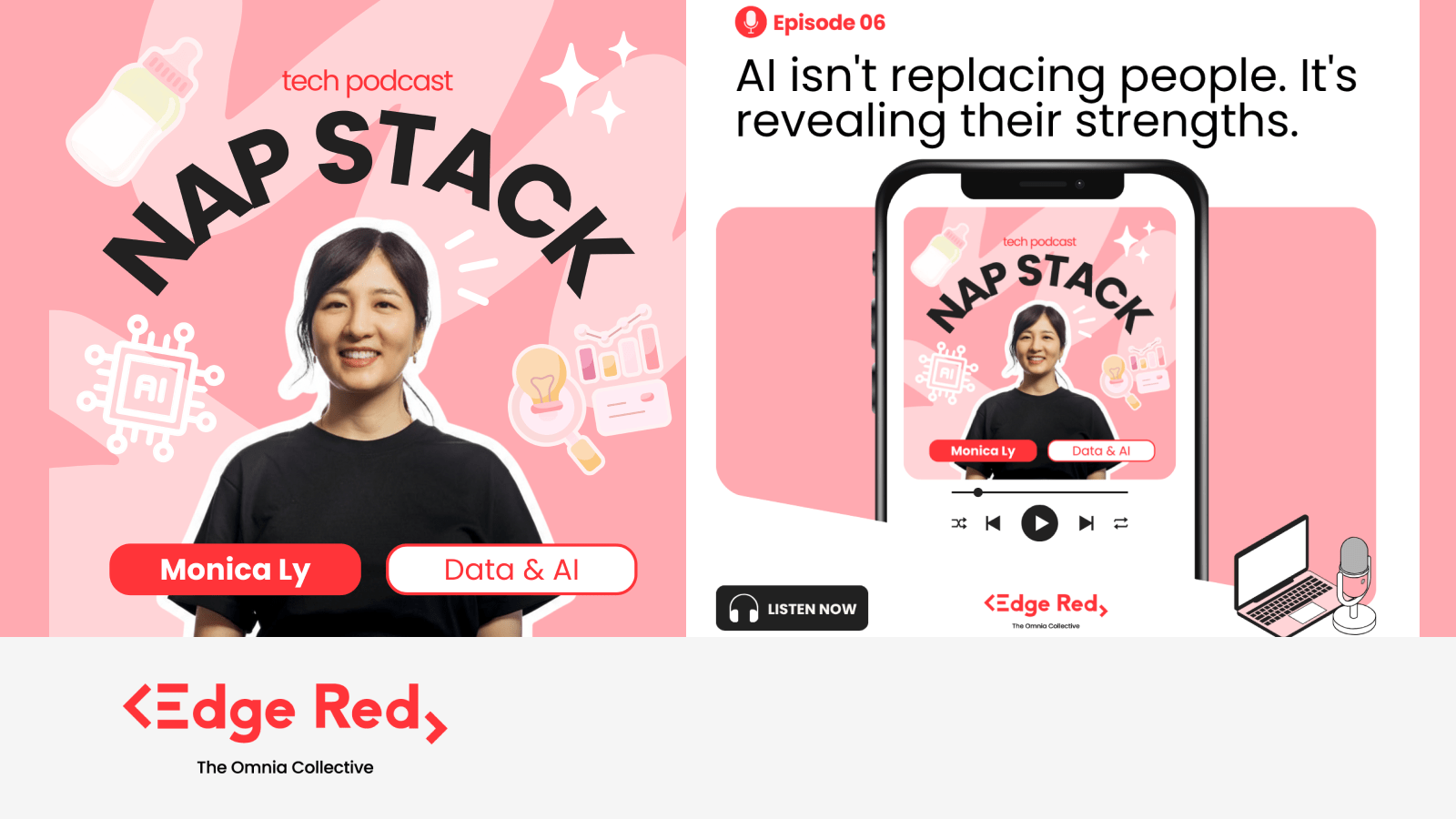
This post is adapted from Episode 6 of Nap Stack, Monica’s podcast on AI, data, and building a business. [Listen here.]
The thinking was always there
I’ve seen this with people I know well. One person on my team is excellent at making sense of complex problems. Give them something messy and they’ll find the pattern. That was never the issue. The issue was getting that thinking onto a page in a way a client could quickly use. The insight was always there. The write-up took a long time.
Once they started using AI for that part, the gap closed fast. Not because AI did the thinking – because AI handled the bit that was slowing them down.
Someone else does their best work when they can properly focus. Strong judgment, but like most of us, constantly interrupted – meetings, messages, switching between six things at once. Every time they got pulled away, they had to rebuild context before they could think again. AI helped by holding that context for them. A quick summary of where things stood, what had been decided, what still needed attention. Instead of spending twenty minutes getting back up to speed, they were straight back into the problem.
In both cases, the capability was already there. AI just removed what was blocking it.
It works the other way too
If someone’s judgment isn’t strong, AI won’t fix that. It might help them produce more. It might help them look more polished. But better output isn’t the same as better decisions.
What AI actually does is make things clearer. The people who were being held back by a specific weakness start performing differently once that weakness is less relevant. And the people who weren’t being held back by a weakness? That becomes clearer too.
Here’s my own example. Numbers have always come naturally to me. Turning ideas into something polished and structured hasn’t – even this podcast goes through AI before it gets published. My co-founder is the opposite. Writing was never his bottleneck, so he built something to manage his inbox instead. Works brilliantly for him. I looked at it and had no interest. Managing my inbox was never the thing slowing me down.
Completely different value. Same tool.
When I look at our team, the result hasn’t been about doing more with fewer people. It’s been about removing the things getting between good people and their best work – and seeing them perform at a much higher level as a result.
So what do you actually do about it?
Start with a conversation. Ask each person on your team where they feel like they’re in flow – and where they feel like they’re pushing uphill. Most people know exactly which parts of their job come easily and which parts cost them. You just have to ask.
Once you know where the friction is, that’s where you start thinking about AI. Not a blanket rollout across the team. At the specific thing that’s slowing each person down.
Then watch what changes. When the hard parts get easier, people show you what they’re actually capable of. Some will surprise you. Some won’t. But either way, you’ll have a much clearer picture of where the real capability sits in your team – and where it doesn’t.
About Nap Stack
Nap Stack is an Australian business podcast hosted by Monica Ly, co-founder of EdgeRed — an Australian data & AI consultancy (part of The Omnia Collective). Each episode is five minutes on AI adoption, data strategy, and the decisions senior leaders are actually making right now. It’s practical, no-hype, and built for executives and business owners — not technologists. New episodes drop weekly. Find Nap Stack on Spotify.
![[Nap Stack] Is AI in the job or just the title?](https://edgered.com.au/wp-content/uploads/2026/07/How-to-hire-AI-talent_-Is-AI-actually-in-the-job-or-just-the-title_.png)
![[Nap Stack] AI makes a decision about your customer? You may have to disclose it](https://edgered.com.au/wp-content/uploads/2026/07/When-AI-makes-a-decision-about-your-customer-you-may-now-have-to-say-so.png)
![[Nap Stack] Synthetic research: faster insights, but can you trust them?](https://edgered.com.au/wp-content/uploads/2026/06/You-approved-it-but-did-anyone-ask-a-real-customer_.png)