
You approved it - but did anyone ask a real customer?
17 Jun 2026
What synthetic research actually is
Synthetic research uses AI to simulate customer responses rather than gathering them from real people. Instead of recruiting participants, running interviews, and waiting weeks for analysis, you ask an AI to roleplay as your customer segment and generate what they might say. Faster, cheaper, and increasingly convincing.
It’s catching on with Qualtrics reporting that 71% of market researchers believe the majority of market research will be synthetic within three years.
Where it actually helps
The use cases that work are the exploratory ones — stress-testing a proposition, building out personas, getting a team aligned on who the customer is before committing to a full study. Tasks that used to take a week or two can now happen in hours.
Bound has seen it firsthand in financial services. What used to be a month-long process to get baseline qual and quant data to a customer journey team can now happen in a day. As a starting point, that compression is genuinely useful.
Where it goes wrong
The problem isn’t the tool. It’s when synthetic insight gets treated as evidence.
AI-generated customers will validate things a real customer wouldn’t. They’re helpful by design. They don’t get confused, they don’t change their mind halfway through, and they don’t accidentally say the thing that reframes your entire proposition. As Oz puts it: “companies can get very lazy. It’s very easy just to go into a simulator and ask if a product is valid or not.”
But real humans aren’t a one-way stream. They have lived experience. They stutter. They rethink. They tell you one thing and do another. That gap between what people say and what they actually do is often the most valuable data in the room, and synthetic research will never surface it. No two studies are the same, because no two humans are the same. Lived experience, brand perception, individual maturity and willingness to change — a model predicting what a customer type would say captures none of it.
The downstream risk is false precision. You get a clean, confident-looking output. The messy signal that would have changed your decision never surfaces.
When to use synthetic vs actual research?
Start with the decisions. What are you actually trying to make off the back of this research? What do you need real humans to validate?
If you’re exploring, aligning a team, or pressure-testing an early idea — synthetic research can move you faster. If you’re deciding whether to launch something, price it, or build it — talk to real people first.
The speed is real. So is the risk of mistaking a confident-sounding output for something you’ve actually earned the right to act on.
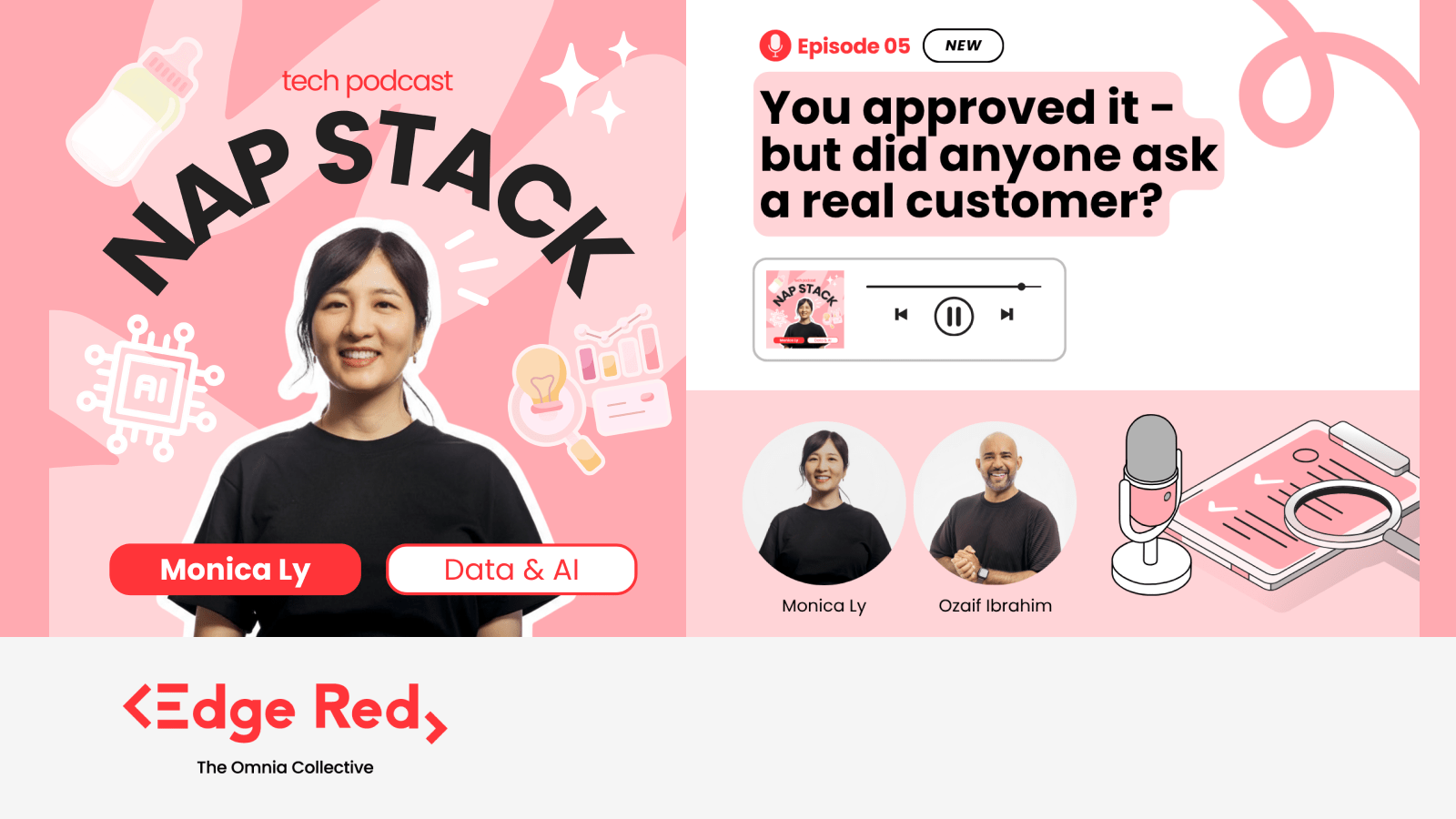
This post is adapted from Episode 5 of Nap Stack, Monica’s podcast on AI, data, and building a business. [Listen here.]
About our guest
For this episode of Nap Stack, we brought in Ozaif Ibrahim, Experience Design Partner at The Omnia Collective and Partner at Bound Digital, a digital experience consultancy that helps organisations co-create future products and services with their customers. Oz has spent over 20 years working across experience strategy, service design and product design with leading brands in banking, insurance, utilities and health – and he’s watching this shift happen in real time.
About Nap Stack
Nap Stack is an Australian business podcast hosted by Monica Ly, co-founder of EdgeRed – an Australian data & AI consultancy (part of The Omnia Collective). Each episode is five minutes on AI adoption, data strategy, and the decisions senior leaders are actually making right now. It’s practical, no-hype, and built for executives and business owners – not technologists. New episodes drop weekly.
Find Nap Stack on Spotify and Apple Podcasts.

![[Nap Stack] Most AI programs stall for non-AI reasons](https://edgered.com.au/wp-content/uploads/2026/07/AI-didnt-break-your-business.-Your-operating-model-did.png)
![[Nap Stack] Time saved isn't the AI business case](https://edgered.com.au/wp-content/uploads/2026/07/Time-savings-isnt-the-AI-business-case.-Its-the-starting-point.png)
![[Nap Stack] Is AI in the job or just the title?](https://edgered.com.au/wp-content/uploads/2026/07/How-to-hire-AI-talent_-Is-AI-actually-in-the-job-or-just-the-title_.png)