
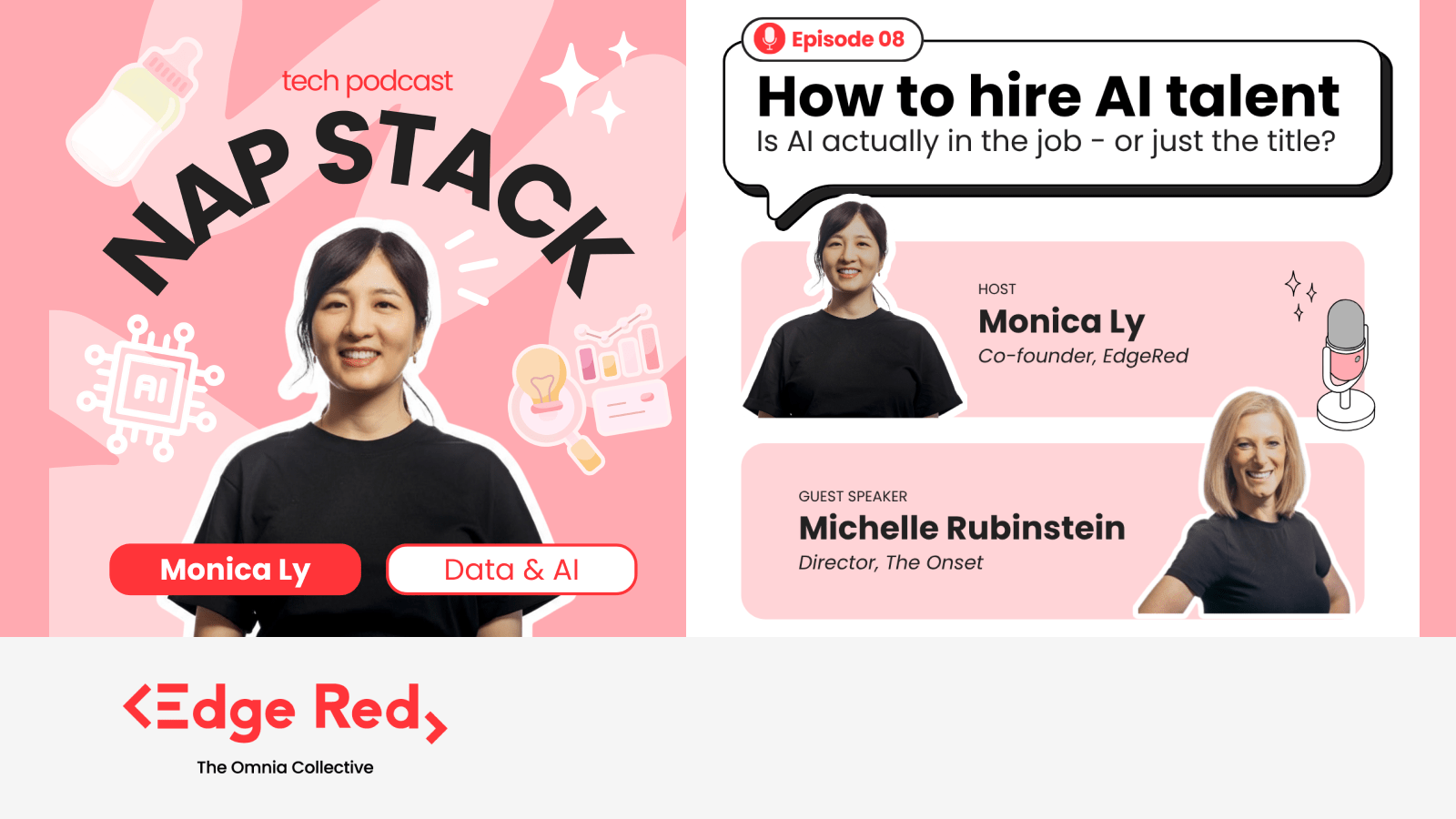
How to hire AI talent: Is AI actually in the job - or just the title?
7 Jul 2026
The rise in AI job titles
AI job titles have exploded. In Australia, Head of AI roles grew 28% in a single year. AI Engineer roles grew 37%. And somewhere in the middle of all that growth, senior leaders are approving headcount for roles they don’t fully understand.
Some AI roles are genuinely new. But a decent proportion are existing jobs with “AI” bolted on the front. Five years ago it was Digital Marketing Managers. Then Growth Marketing Managers. Now it’s AI Growth Managers. The fundamentals haven’t changed much – what’s changed is the expectation that AI is part of the toolkit, not a nice-to-have. The businesses getting it right aren’t hiring AI for the sake of it. They’re hiring people who use AI to solve commercial problems – reduce costs, improve customer experience, speed up decisions, drive revenue. That’s where the value sits, regardless of what the title says.
The questions leaders aren’t asking
Too many hiring conversations start with “we need an AI person.” That’s like saying “we need someone who’s good at Excel.” It’s a tool, not a strategy. The question that should come first: what business problem are we actually trying to solve? Closely followed by: does our data even support an AI strategy?
From there, the checklist is short but revealing:
- What outcome do we expect this person to deliver?
- How will we measure success in six or twelve months?
- Could AI augment the existing team instead of adding headcount?
- Does this person understand our business, or just the technology?
- Can they influence and tell a story well enough to get buy-in?
The best AI hires are connectors and translators. They can speak to engineers in the morning, commercial teams in the afternoon, and executives by the end of the day. That’s rarer than knowing the latest model or platform.
The cost of a bad hire
The salary is usually the cheapest part. A poor senior AI hire can cost two to three times that once you add recruitment fees, onboarding, lost productivity, delayed projects and opportunity cost.
But the biggest cost is confidence. Some organisations spend twelve months recovering from a hire who over-promised what AI could deliver. The business turns sceptical, funding dries up, and genuinely valuable initiatives get shelved because everyone concludes “we tried AI and it didn’t work.”
AI didn’t fail. The hiring decision did.
What to look out for
Don’t hire for AI expertise alone. Hire for commercial impact, curiosity and influencing skills. The strongest candidates don’t spend the interview talking about models and prompts – they tell you how they cut costs by 30%, took a process from days to minutes, or generated new revenue.
Technology changes every six months. The ability to solve business problems doesn’t. In twelve months there’ll be another wave of AI tools. The person who knows how to create value will still be valuable. The person who only knows one tool is on a slippery slope to nowhere.
This post is adapted from Episode 8 of Nap Stack, Mon’s podcast on AI, data, and building a business. [Listen here.]
About our guest
On this episode of Nap Stack, we spoke with Michelle Rubinstein, Director at The Onset, a Sydney-based specialist tech and go-to-market recruitment agency. Michelle’s spent 25+ years in recruitment, was named RCSA Recruitment Professional of the Year in 2023, and made this year’s Atlas Top 100 ANZ Leaders list. She’s spent her career inside global firms, boutique agencies and corporate teams alike, so she’s seen the hiring market from every angle.

![[Nap Stack] Why AI proofs of concept stall before production](https://edgered.com.au/wp-content/uploads/2026/10/Why-AI-proofs-of-concept-stall-before-production.png)
![[Nap Stack] How Asia's AI infrastructure boom should change how Australia invests](https://edgered.com.au/wp-content/uploads/2026/09/How-Asias-AI-infrastructure-boom-should-change-the-way-Australian-leaders-invest.png)
![[Nap Stack] What AI adoption in the public sector actually looks like right now](https://edgered.com.au/wp-content/uploads/2026/09/What-AI-adoption-in-the-public-sector-and-higher-education-looks-like-right-now.png)