The month Australia didn't sleep: what the numbers say about the Socceroos
27 Jul 2026
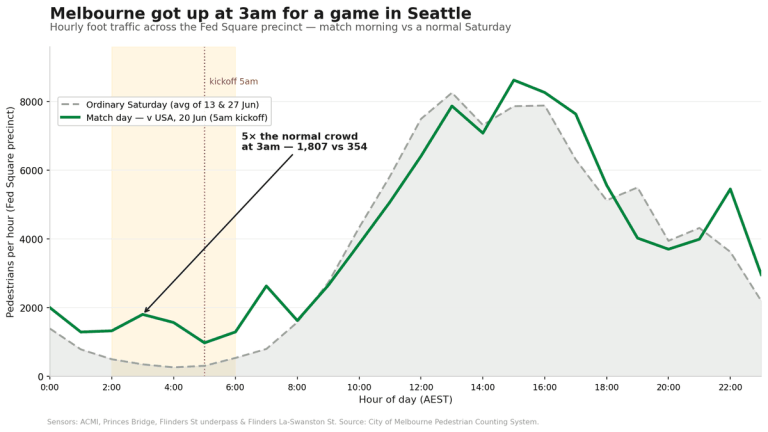
At 3am, Federation Square had five times its normal foot traffic
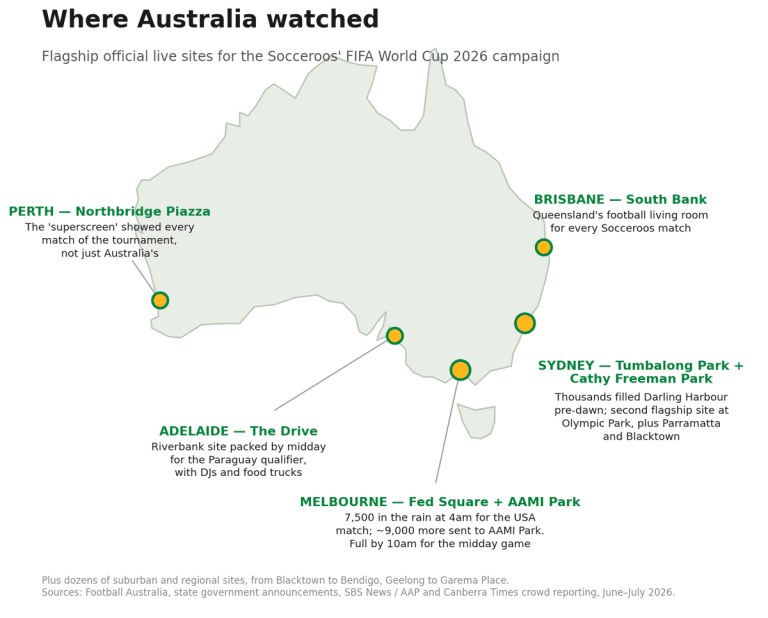
At 3 o’clock on the morning of Saturday 20 June, 1,807 people walked through the Federation Square precinct in Melbourne. On an ordinary Saturday, that number is 354. It was winter. It was raining. Kickoff was still two hours off, and it was happening in Seattle, 13,000 kilometres away. By the time the whistle blew, about 7,500 fans had packed Fed Square to capacity and roughly 9,000 more had been redirected up the road to AAMI Park.
That was one morning, in one city. Over four weeks, the Socceroos’ FIFA World Cup campaign reached a cumulative TV audience of 16.2 million Australians, more than 58% of the country. We went looking for the data trail a football tournament leaves on a nation, and this is what we found.
Four matches, one national sleep deficit
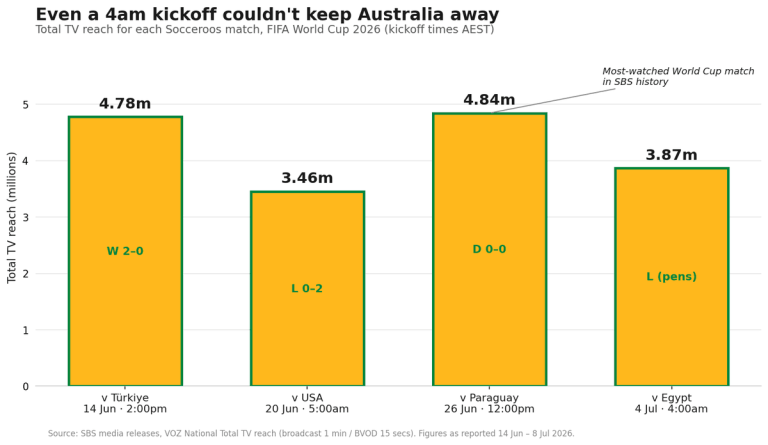
The North American time zones handed Australia a strange fixture list: one afternoon game, one lunchtime game, and two alarms set for the dead of night.
The opener against Türkiye (won 2–0, 2pm AEST on 14 June) reached 4.78 million Australians and set new records for SBS under the current ratings system. The 5am heartbreaker against the USA (lost 0–2, 20 June) still pulled 3.46 million before sunrise. The midday draw with Paraguay on Friday 26 June, the result Australia needed to advance, reached 4.84 million, the most-watched World Cup match in SBS history and the network’s second-biggest broadcast ever, behind only the fabled 2005 Uruguay qualifier. And the 4am Round-of-32 knockout against Egypt on 4 July, which ended the campaign in a penalty shootout after a 1–1 draw, still drew almost 4 million people out of bed.
The city that assembled in the dark
Broadcast numbers prove people were awake. The live sites prove they went out. Every capital ran free official watch sites: Federation Square and AAMI Park in Melbourne, Tumbalong Park and Cathy Freeman Park in Sydney, South Bank in Brisbane, Northbridge Piazza in Perth and The Drive in Adelaide, plus dozens of suburban and regional screens from Blacktown to Bendigo. Fed Square opened its gates well before dawn: 2am for the Egypt knockout, and roughly the same for the USA match. For the midday Paraguay match, it was full by 10am, two hours before kickoff.
What the sensors saw
Melbourne is the only Australian capital that publishes comprehensive hour-by-hour pedestrian counts as open data, through a sensor network that has been running since 2009. That makes it the one place where we can measure precisely what a 4am kickoff does to a city street, so we pulled the data.
The answer: on USA match morning, foot traffic through the Fed Square precinct ran at five times its normal level at 3am. The Egypt knockout a fortnight later produced an even bigger pre-dawn surge. These are counts of people passing the sensors, not modelled estimates.
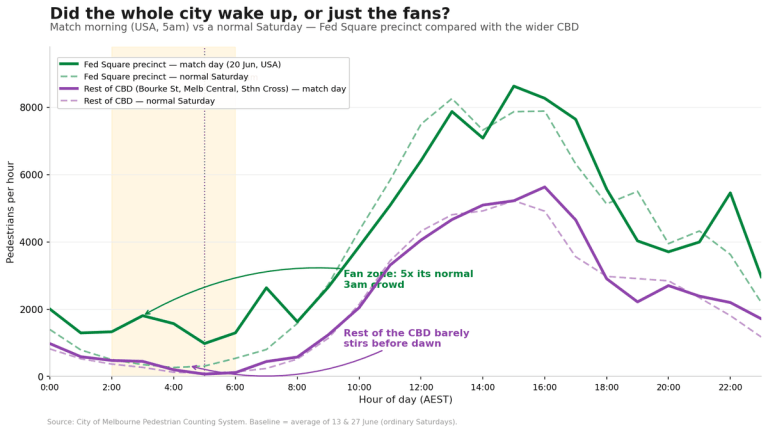
And here’s the detail we didn’t expect. We also checked sensors well away from the fan zone, at Bourke Street Mall, Melbourne Central and Southern Cross, to answer a simple question: did the whole city wake up, or just the fans? The answer is emphatic. The fan-zone sensors surged before dawn while the rest of the CBD barely stirred. The reported crowds tell the same story, with roughly 7,500 packing Fed Square and another 9,000 or so redirected to AAMI Park. The result was a green-and-gold migration into a couple of city blocks while everyone around them slept. There’s also a coda in the data: once the match ended, foot traffic returned to a normal Saturday baseline. The 3am surge left no daytime residue.
One team, one national heartbeat
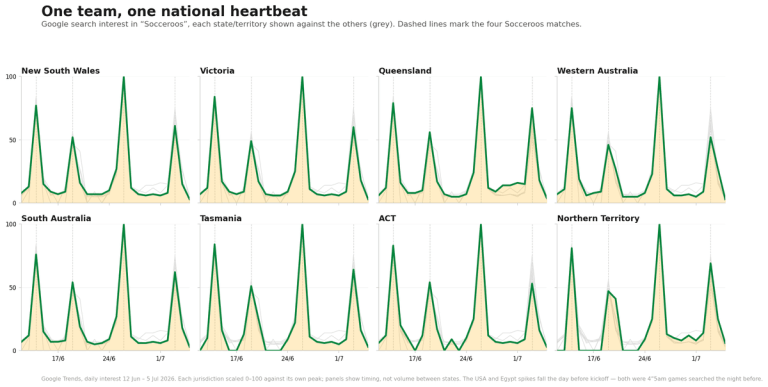
Search data adds the national rhythm. We pulled Google Trends’ interest in “Socceroos” for every state and territory across the tournament, and the striking thing isn’t difference. It’s unison. Every jurisdiction produced the same four spikes, and every one of them peaked on the same day: 26 June, the Paraguay match that sent Australia through. (A note on reading the chart: Google scales each state against its own peak, so the lines show timing and shape, not search volume between states. No rivalry verdicts here, just synchronised obsession.)
One behavioural quirk worth savouring: for the two pre-dawn games, the search spike landed the day before kickoff. The nation was Googling kickoff times and live sites the evening before, then setting alarms.
The match-day economy, in one snapshot
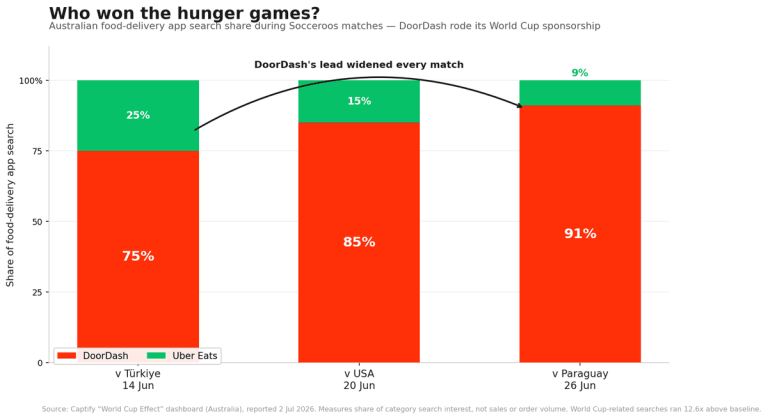
Hard spending data for Australian match days isn’t publicly released. Banks and delivery platforms keep it private. But one genuinely measured snapshot did emerge. Search-intelligence firm Captify tracked which food-delivery app Australians were searching during the matches, and DoorDash, riding its role as an official tournament supporter, progressively took over the category by search interest, moving from a 75% share during the Türkiye match to 85% during the USA game and 91% by Paraguay (Captify’s dashboard covered the group stage; equivalent figures for the Egypt knockout haven’t been published). To be precise about what that measures: its share of search interest, brand buzz, not orders or dollars. But as a picture of how completely a sponsorship can dominate category search interest during the moments that matter, it’s hard to beat.
The productivity question
The Paraguay match kicked off at noon on a Friday, in the final week of school term across most states. The country made an unofficial collective decision. The Treasurer said he expected employers would be understanding if staff didn’t make it back after lunch, predicting a few long lunches if Australia won. The Prime Minister publicly urged bosses to act in the national interest. Students told TV crews, cheerfully and on camera, that they were skipping the final day of term. NSW let pubs open from 3am for the knockout; Victoria let venues trade all night. Governments were, in effect, rewriting trading hours around a football match.
And here’s the finding we didn’t expect: Google searches for “sick leave” and “call in sick” didn’t spike on match day, and if anything they eased. With a noon kickoff there was little need to feign illness, and the flat search line fits a day when the time off was taken out in the open, in long lunches with the Treasurer’s blessing, rather than disguised as a sickie.
The takeaway
This is the kind of thing we do at EdgeRed, usually with less football. Most events in a business leave data trails across systems that nobody quite connects: a launch, a campaign, a customer behaviour shift, an operational surprise. Individually, each source tells you a fragment. Stitched together, the whole story becomes visible.
The data says something simple: given a reason, Australians will reorganise an entire day, sleep, school, work, winter rain, around ninety minutes of football, and the trace of it shows up everywhere from pedestrian sensors to search engines to the national TV ratings. For a month, the country was running on North American time. The Socceroos are out. Nobody, as far as the data can tell, regrets the lost sleep.
Sources
- SBS media releases and Mediaweek/AdNews/B&T/TV Central reporting — per-match VOZ reach figures; 16.2M cumulative reach; Egypt penalty-shootout result.
- SBS News, AAP/Canberra Times — Fed Square 7,500 crowd and ~9,000 AAMI Park redirect; capacity-by-10am; Tumbalong Park and The Drive crowds; Treasurer and PM comments; pub trading-hours changes.
- City of Melbourne Open Data Portal — Pedestrian Counting System (counts per hour); sensors 72, 5, 6, 209, 41 (Fed Square precinct), controls 2, 3, 135. Baselines: 13 & 27 June.
- Google Trends — “Socceroos” daily interest by state/territory, 12 Jun–5 Jul 2026; “sick leave”/”call in sick”, 1 Jun–5 Jul 2026.
- Captify “World Cup Effect” dashboard via Mediaweek/Mi3/B&T (2 Jul 2026) — food-delivery search share.
- Socceroos.com.au, football360.com.au, NSW Government, Fed Square — live-site locations and operations.
This blog was written by Archit Arggawal.
About EdgeRed
EdgeRed is an Australian AI and data consultancy, part of The Omnia Collective group, with teams in Sydney and Melbourne. We build things that work in production – agentic AI, machine learning, data engineering, and Microsoft Fabric implementation. 250+ projects. 100+ clients. 100% Australian onshore team.