
Frontier or open source AI: what leaders should actually weigh
12 Aug 2026
Someone on your team is about to ask you to choose between a frontier model and an open source one. It might be your CTO. It might be a vendor. It might be a conversation you overheard this morning. Frontier versus open source is everywhere right now.
Most leaders frame it as a technology decision, but it isn’t. The trade-off is commercial, and the smartest AI choice for your business isn’t always the smartest AI model.
What each one is
Frontier models are what you’re probably already using. ChatGPT, Claude, Gemini. Built by companies that have spent billions of dollars on training. You access them over the internet and pay per use. Breakthroughs appear here first. If a new reasoning capability arrives tomorrow, it will almost certainly be in a frontier model before it’s anywhere else.
Open source models like Llama and Mistral work differently. You can download them and run them on your own infrastructure. You don’t pay per request, you pay to run the model. In return, you get more control over deployment and how deeply the model sits in your systems.
A useful analogy: a frontier model is like ordering from a restaurant. Someone else cooks, you pay for what’s on your plate. Running an open source model is like running your own kitchen. You control everything from ingredients to knives, but you’ll also need chefs and someone to keep the place running when things break.
The cost surprise most teams don’t see coming
AI is getting expensive quickly. Canva recently reduced its revenue forecasts because of how expensive its new AI features have turned out to be. It’s now rebuilding to rely less on frontier models to bring costs down.
Frontier models are priced on usage. Fine on low volumes. Once you have AI running documents, workflows, and queries all day, the bill adds up quickly.
You’ll hear the “80/20 rule” a lot in industry: 80% of the capability for 20% of the cost. It isn’t scientific and it varies use case by use case, but it’s why open source models are getting so much attention. For what most organisations need day to day, an open source model is good enough.
The catch: no licence fees doesn’t mean no cost. Someone still has to deploy the model and own it when things break. Both paths have real costs. The question is which costs make sense for how much you want to scale AI, and who’s going to own it.
Where your data ends up
Most frontier services process your requests on infrastructure owned by the model operator or their cloud provider. For most organisations, that’s perfectly fine. If you’re in financial services, healthcare, government, or you handle highly sensitive information, it might not be.
You may need to know exactly where your data is being processed, and whether that meets your regulatory obligations. In early 2025, the Australian government banned the use of DeepSeek in its systems over data and national security concerns. Decisions like that can rearrange a vendor conversation quickly. In recent conversations with leaders, data sovereignty has become one of the strongest reasons open models are being considered.
The people problem
Open source only works if your team can own it. Deploying a model is the easy part. Keeping it running, secure, and up to date is the harder job, and it doesn’t stop.
Without those skills in-house, the promised cost savings disappear quickly, replaced by external contractors or platform bills you weren’t planning for.
Three questions to ask before your team commits
If someone brings you a model recommendation, ask three things.
- What’s the total cost of the volume we expect to be running in two years? Not just the licence cost. The full cost of running the model at scale.
- Do we know where the data will be processed, and does that align with our regulatory or organisational obligations?
- Does the team have the skills to own this, or are we creating a brand new dependency?
Once you’ve answered those, you’re not really asking which AI is best. You’re asking which one fits.
The best AI model for your business is the one that fits your budget, your risk profile, and the team that has to keep it running once the vendor calls stop.
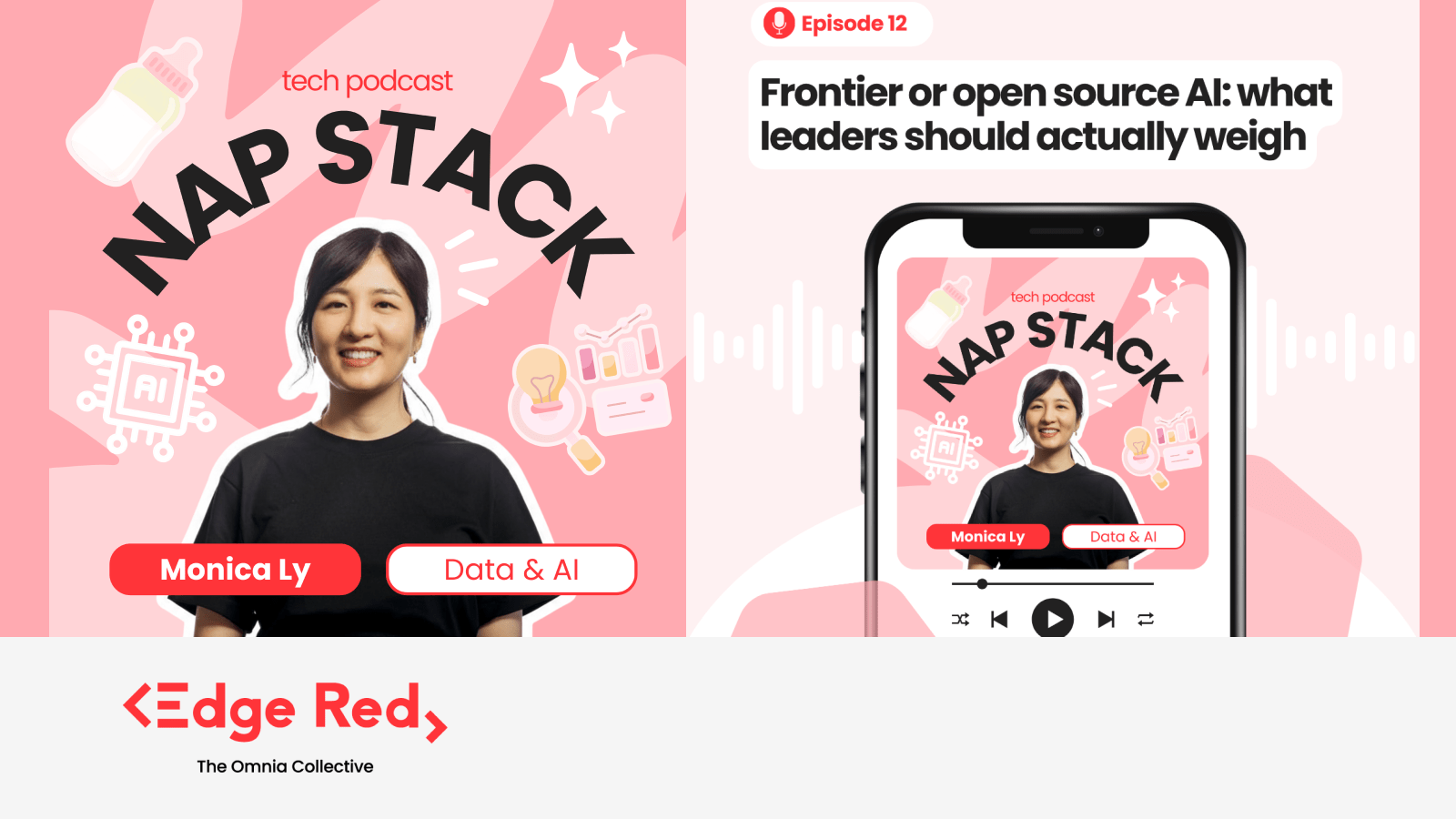
This post is adapted from Episode 12 of Nap Stack, Mon’s podcast on AI, data, and building a business. [Listen here.]
About Nap Stack
Nap Stack is an Australian business podcast hosted by Monica Ly, co-founder of EdgeRed – an Australian data & AI consultancy (part of The Omnia Collective). Each episode is five minutes on AI adoption, data strategy, and the decisions senior leaders are actually making right now. It’s practical, no-hype, and built for executives and business owners – not technologists. New episodes drop weekly.
Find Nap Stack on Spotify and Apple Podcasts.

![[Nap Stack] Why AI proofs of concept stall before production](https://edgered.com.au/wp-content/uploads/2026/10/Why-AI-proofs-of-concept-stall-before-production.png)
![[Nap Stack] How Asia's AI infrastructure boom should change how Australia invests](https://edgered.com.au/wp-content/uploads/2026/09/How-Asias-AI-infrastructure-boom-should-change-the-way-Australian-leaders-invest.png)
![[Nap Stack] What AI adoption in the public sector actually looks like right now](https://edgered.com.au/wp-content/uploads/2026/09/What-AI-adoption-in-the-public-sector-and-higher-education-looks-like-right-now.png)