
What AI adoption in the public sector and higher education looks like right now
23 Sep 2026
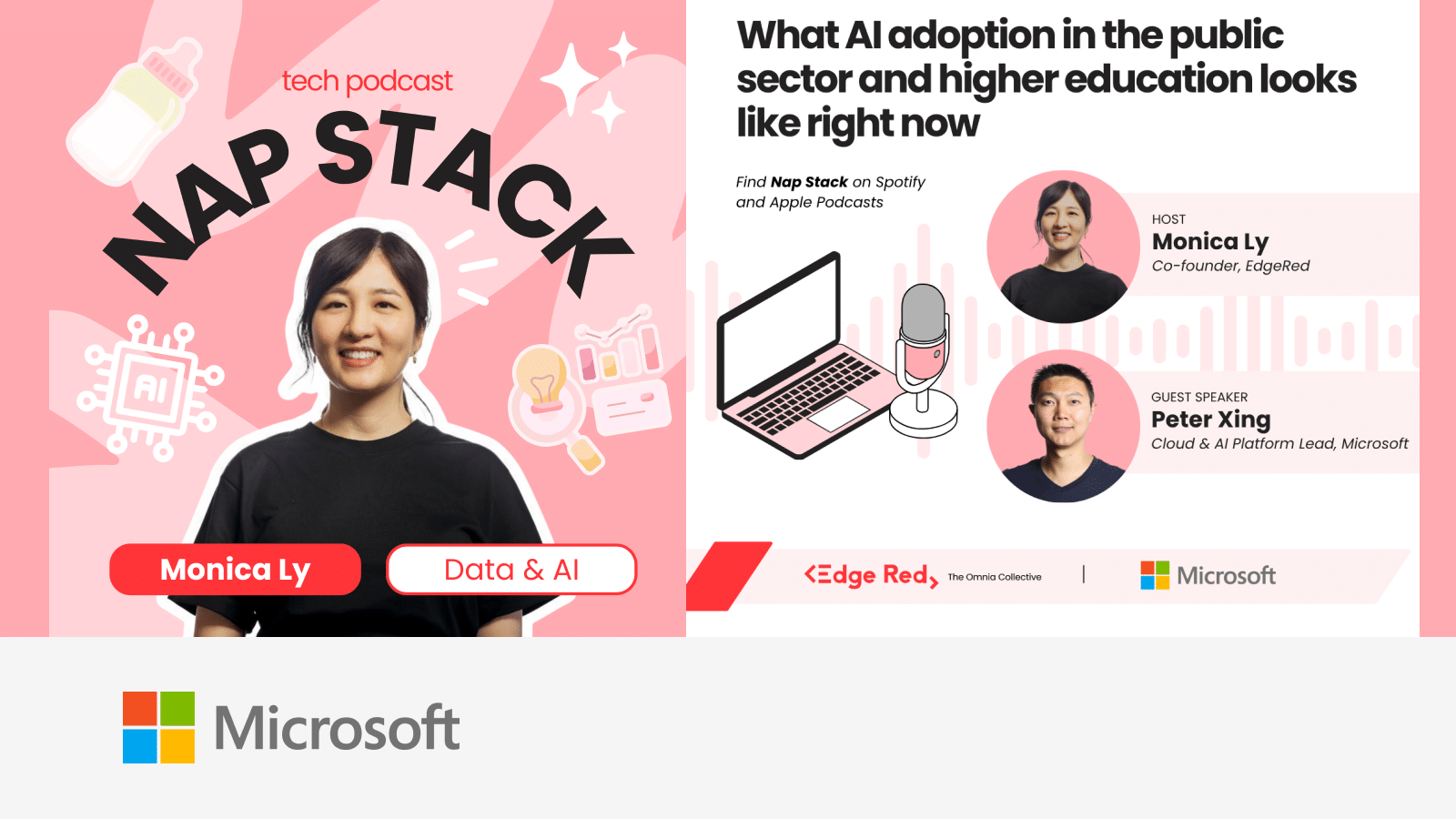
A year ago, most conversations with public sector and education leaders about AI were about proving ROI: could adoption actually move the needle across an organisation. This year, the conversation has shifted. The value is not something you prove in a slide deck anymore. It shows up the moment you unlock the tools for the people actually doing the work. That is the view from Peter Xing, who leads cloud and AI platforms for public sector and education at Microsoft, on the latest episode of Nap Stack.
From proving value to unlocking it
“We’ve gone from initial adoption and trying to do innovation to then trying to find the value,” Xing says. “This year is actually just seeing that the value comes out as a result of just unlocking it for the actual users.”
At the universities Xing works with, GitHub Copilot adoption among developers is the clearest example: work that used to take days or weeks now happens in an afternoon, helped along by newer model capabilities like OpenAI’s GPT-6 Astra and Anthropic’s Fable 5.1. The remaining problem, in his view, is not technical. It is enabling every part of the public sector to extend that same access to their own end users.
AI is changing how people learn, not just how they work
Higher education is dealing with a harder version of the same shift. Cognitive offloading, students defaulting to AI on anything that requires sustained thinking, has become a real concern on campuses, alongside headlines about strike action and disputes over how learning should be assessed in an AI-saturated environment.
The University of Sydney’s response is a two-lane model for assessment, developed through its Cogniti platform under Professor Danny Liu, who leads educational innovation there. One lane keeps traditional, in-person assessment to confirm students have actually learned the material.
The other lane lets AI augment the experience, including through Cogniti agents, digital stand-ins for teachers that students can access at any hour, built by teachers themselves and aligned to their own curriculum.
“That regular interval of assessing in person, making sure the learning journey is there, that’s the whole two-lane approach,” Xing says. Sydney and a growing number of other Australian institutions have also backed the Castlereagh Statement, a national call for coordinated action on AI in education released in June 2026.
Preparing for the next one to two years
Xing’s advice for leaders starts with enablement: getting people access to the tools before worrying about the rest. Much of that conversation traces back to OpenClaw, the open-source agent framework that spread fast through 2026 and raised real questions about what an unsupervised agent should be allowed to do on someone’s own machine.
Microsoft’s answer is Scout, an always-on agent built on the OpenClaw framework but wrapped in enterprise security controls, running on the GitHub Copilot harness alongside a person’s existing Microsoft 365 identity and permissions. Microsoft calls the underlying context layer Work IQ: it draws on a user’s emails, calendar, CRM and documents to prepare for a meeting before it starts, without anyone asking it to.
“That capability means we are now the human interface,” Xing says. For public sector teams carrying heavy administrative load, the pitch is less busywork and more time actually spent on the parts of the job that need a person.
What comes next
Xing’s closing point was less about any specific release and more about pace. Model capability is compounding quickly enough that planning for where it is now, rather than where it is heading, is already out of date. His advice for public sector and education leaders: start enabling access now, build the security foundation properly, and expect a steady run of announcements before the end of the year.
Not sure how to prepare your team for what’s coming
The Omnia Collective works with government and education institutions across Australia as a certified Microsoft Solutions Partner, helping teams move from initial AI adoption to governed, organisation-wide enablement. See our AI & Automation services or get in touch.
This post is adapted from an episode of our Nap Stack podcast on AI, data, and building a business. Listen on Spotify or Apple Podcasts.
About Nap Stack
Nap Stack is an Australian business podcast hosted by Monica Ly, co-founder of EdgeRed – an Australian data & AI consultancy (part of The Omnia Collective). Each episode is five minutes on AI adoption, data strategy, and the decisions senior leaders are actually making right now. It’s practical, no-hype, and built for executives and business owners – not technologists. New episodes drop weekly.
Find Nap Stack on Spotify and Apple Podcasts.

![[Nap Stack] How Asia's AI infrastructure boom should change how Australia invests](https://edgered.com.au/wp-content/uploads/2026/09/How-Asias-AI-infrastructure-boom-should-change-the-way-Australian-leaders-invest.png)
![[Nap Stack] The low-code lesson AI is about to repeat](https://edgered.com.au/wp-content/uploads/2026/09/The-low-code-lesson-AI-is-about-to-repeat.png)
![[Nap Stack] Fix how you work before you fix it with AI](https://edgered.com.au/wp-content/uploads/2026/09/Fix-how-you-work-before-you-fix-it-with-AI.png)