
Time savings isn't the AI business case. It's the starting point
22 Jul 2026
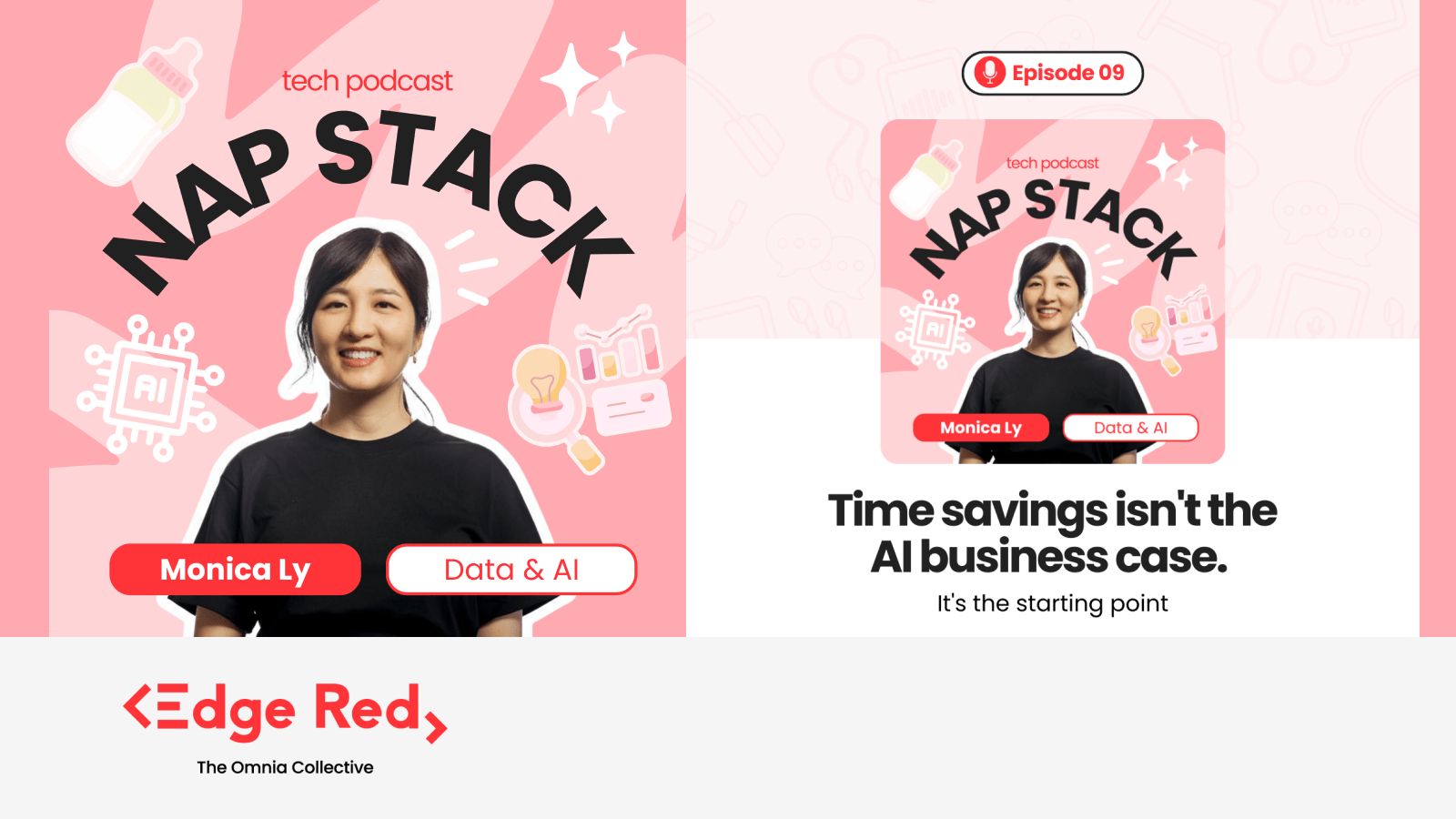
Every AI pilot ends with the same slide: look how much time this will save us. What almost nobody asks next is what people will actually do with that time. That’s where data strategy consulting gets real, and where most business cases stop one step too early.
This post is adapted from Episode 9 of Nap Stack, Mon’s podcast on AI, data, and building a business. Listen here.
Microsoft’s 2025 Work Trend Index found that 80% of leaders and employees say they don’t have enough time or energy to do the work in front of them. AI looks like the obvious fix. But the study’s own framing misses something: saved time isn’t the value. What people do with it is.
I think about this through the dashboard analogy, because I always do. Before dashboards became standard, people spent hours pulling data from different sources, fixing formulas, building slides by hand. Dashboards automated that prep work. Nobody went home earlier. They just stopped producing reports and started reading them, asking better questions of the data instead of assembling it.
AI is doing the same thing, just faster. I saw a task recently drop from 30 minutes to five. Twenty-five minutes saved, on paper. The part worth paying attention to wasn’t the saving. It was what the team did next: the technical specialists freed from that routine task didn’t clock off early, they redirected that time into improving the platform itself.
Where data strategy consulting earns its keep: the second half of the business case
This is why I get nervous when an AI use case is built entirely on hours saved. Two thousand hours a year, great. Doing what instead? Serving more customers? Building a capability that didn’t exist before? Shipping a better product? Most business cases stop at the saving and never answer that question, and I don’t think that does the business case justice.
Here’s what I’d push people to do differently.
First, be honest about whether time saving is actually the endpoint or just the input. If the use case is customer facing and the time saved shows up as shorter wait times or better service, that’s a legitimate destination. Job done.
For internal use cases, it almost never is. Time saved internally is capacity created, not value delivered. The value shows up in what fills that capacity next.
Second, when someone brings you a proposal built on hours saved, spend less energy interrogating the methodology behind the number and more energy on the sentence that usually isn’t there: what will people do with that time. If the answer is vague, the business case isn’t finished, no matter how tight the hours calculation is.
AI creates capacity. What that capacity gets spent on is a leadership decision, not something the tool decides for you.
About Nap Stack
Nap Stack is an Australian business podcast hosted by Monica Ly, co-founder of EdgeRed — an Australian data & AI consultancy (part of The Omnia Collective). Each episode is five minutes on AI adoption, data strategy, and the decisions senior leaders are actually making right now. It’s practical, no-hype, and built for executives and business owners — not technologists. New episodes drop weekly. Find Nap Stack on Spotify.

![[Nap Stack] The low-code lesson AI is about to repeat](https://edgered.com.au/wp-content/uploads/2026/09/The-low-code-lesson-AI-is-about-to-repeat.png)
![[Nap Stack] Fix how you work before you fix it with AI](https://edgered.com.au/wp-content/uploads/2026/09/Fix-how-you-work-before-you-fix-it-with-AI.png)
![[Nap Stack] Follow the money: where AI budgets are actually coming from](https://edgered.com.au/wp-content/uploads/2026/08/Follow-the-money_-where-AI-budgets-are-actually-coming-from-1.png)