
Fix how you work before you fix it with AI
2 Sep 2026
Every leader I speak to is asking the same question: how do we use AI to make our business more productive?
The uncomfortable answer is that a lot of the productivity problem doesn’t sit with the technology. It sits in the workflows the technology is being pointed at. Fix the workflow first, and the AI might not even be needed. Skip that step, and the AI probably won’t help.
What corporate Australia looks like from outside
Step out of a corporate environment and some of the behaviours that felt completely normal start to look ridiculous.
The one that stands out most: the way performance conversations happen. Somewhere along the way, the HR process for managing underperformance stopped being a genuine attempt to engage with someone and became a box-ticking exercise. Forms filled in, ratings generated, people treated as data points rather than colleagues.
The natural next move for a lot of organisations is to make that process even more automated. AI-generated performance ratings. Input a few observations, generate a summary, tick the box faster. Which takes a process that already needed more humanity and strips more of it out.
AI can’t fix an inefficient workflow
Before AI is dropped into a business, there’s usually a lot of low-hanging fruit that would move the needle more.
Update the job descriptions so they actually reflect the work people are doing. Set clear targets and goals. Fix the broken processes everyone has learned to work around. Any of those changes will drive better cost savings or profit outcomes than adding AI on top of the mess.
If you skip that work and just add AI, you’re pointing an expensive tool at an inefficient process, which usually produces the same output faster.
There’s a pattern that captures the current confusion. Some organisations now rank team members by how many AI credits they’ve used. If you’re at the bottom of the leaderboard, you get a nudge to use more. But credit consumption doesn’t equal productivity. Being told to use more of a tool isn’t the same as using it well.
The richness AI collaboration can’t replicate
An anecdote from the episode: when working with a team member with ADHD, they needed to talk through problems more thoroughly but leadership had been conditioned by corporate Australia to move fast: identify the problem, decide the solution, act. The team member wanted to think out loud, explore options, and problem-solve together.
The compromise was one to two hours a week of dedicated “free thinking time.” No emails, no notifications, no half-attention. What came out of those sessions wasn’t the answer either person would have reached alone. It was better, because it combined two genuinely different ways of thinking.
Compare this to AI: as more collaboration shifts to humans-with-tools rather than humans-with-humans, that same richness quietly disappears. As leaders, we don’t always have the best answer. We just have an answer. AI is very good at giving you an answer. What it isn’t good at is the messier, slower conversation that produces a better one.
Before you throw AI at a productivity problem
Stop the knee-jerk reaction to top-down direction. The buck has to stop somewhere, but not in the first ten minutes.
Create space for your team to think and brainstorm together, without the pressure to land on a decision immediately. The solutions that come out of that space usually help you move faster later, not slower. And they’ll almost always be better than the ones you and an AI arrived at alone.
Fix how you work first. Then decide where AI belongs.
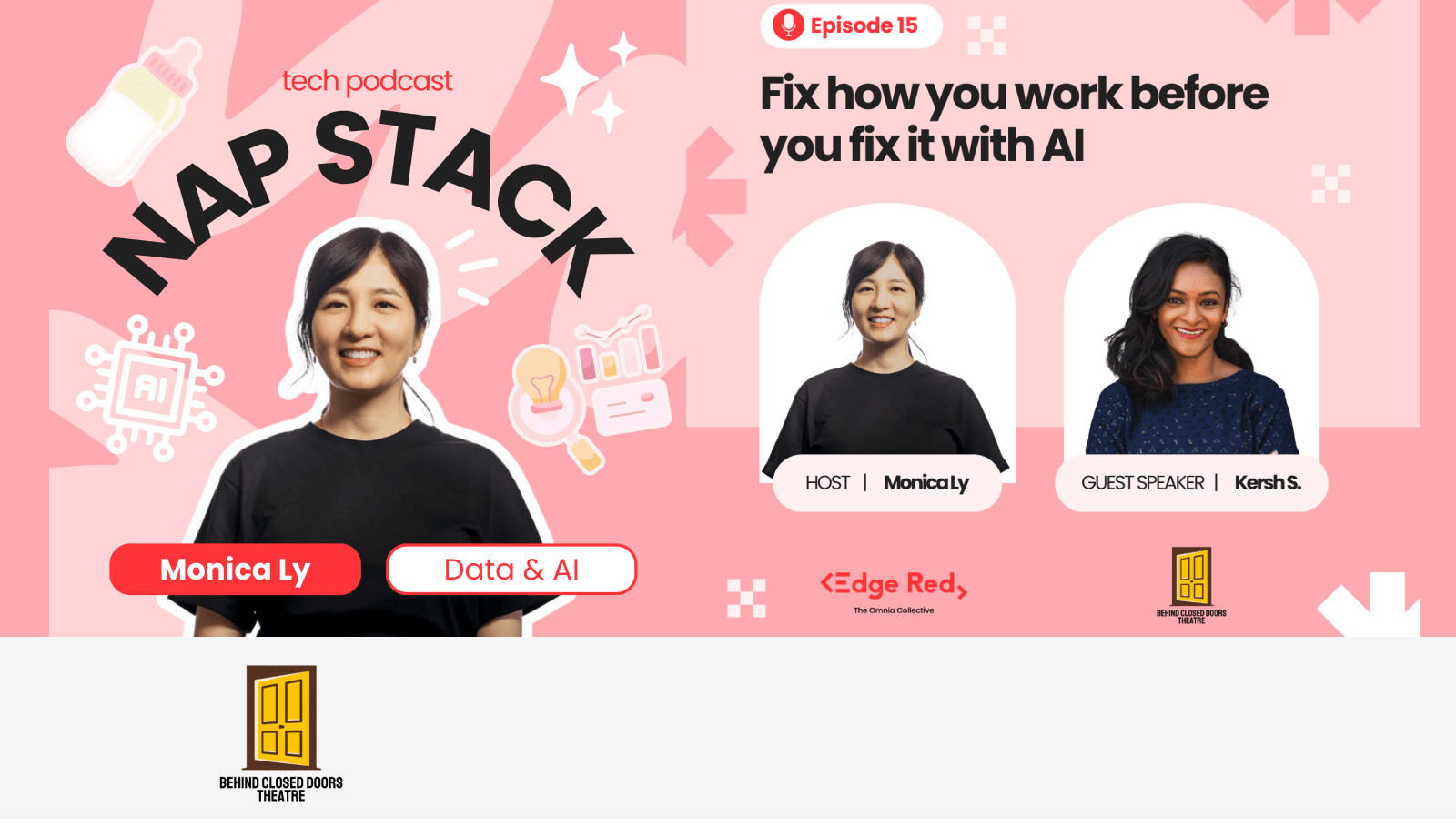
This post is adapted from Episode 15 of Nap Stack, Mon’s podcast on AI, data, and building a business. [Listen here.]
About our guest
On this episode of Nap Stack, we spoke with Kersh Sivakumaran, founder of BCD Theatre and a senior leader whose career spans Woolworths, GetUp and Mamamia, where she has built data analytics functions from the ground up. Alongside her corporate work, Kersh writes and directs theatre. Her latest work, The Algorithm of Us, is a comedy about corporate Australia showing at Sydney Fringe Festival in Lane Cove from 16 to 19 September.
About Nap Stack
Nap Stack is an Australian business podcast hosted by Monica Ly, co-founder of EdgeRed – an Australian data & AI consultancy (part of The Omnia Collective). Each episode is five minutes on AI adoption, data strategy, and the decisions senior leaders are actually making right now. It’s practical, no-hype, and built for executives and business owners – not technologists. New episodes drop weekly.
Find Nap Stack on Spotify and Apple Podcasts.

![[Nap Stack] How Asia's AI infrastructure boom should change how Australia invests](https://edgered.com.au/wp-content/uploads/2026/09/How-Asias-AI-infrastructure-boom-should-change-the-way-Australian-leaders-invest.png)
![[Nap Stack] What AI adoption in the public sector actually looks like right now](https://edgered.com.au/wp-content/uploads/2026/09/What-AI-adoption-in-the-public-sector-and-higher-education-looks-like-right-now.png)
![[Nap Stack] The low-code lesson AI is about to repeat](https://edgered.com.au/wp-content/uploads/2026/09/The-low-code-lesson-AI-is-about-to-repeat.png)