
We've seen this before - The Tableau Analogy
20 May 2026
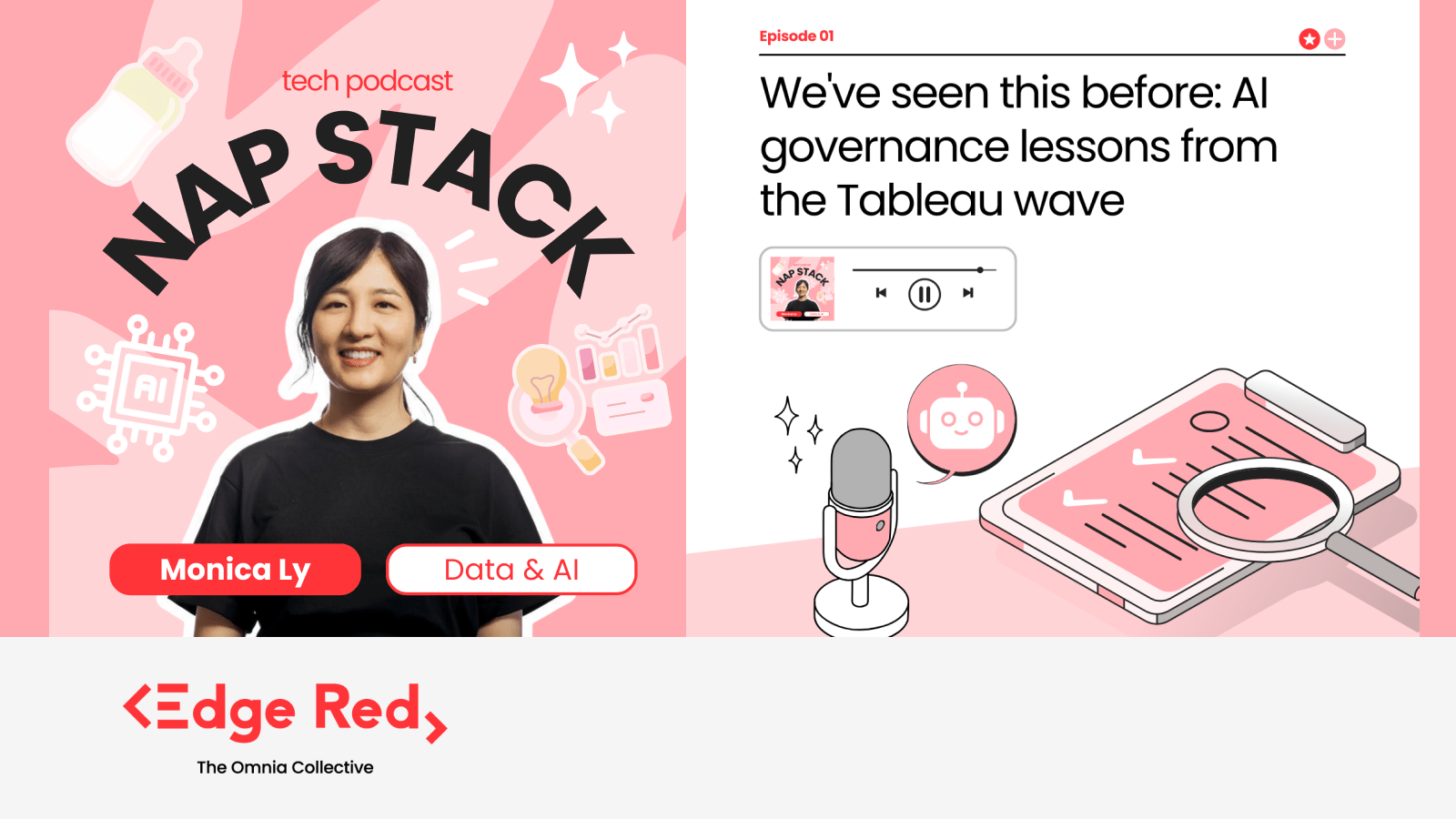
Most people making decisions about AI right now are doing it on data they wouldn’t fully stand behind if they’d built it themselves. The pressure to move is real. But this pattern isn’t new. It just used to be slower.
This post is adapted from Episode 1 of Nap Stack, Mon’s podcast on AI, data, and building a business. Listen here.
Cast your mind back to when Tableau started becoming widely used. It felt like a genuine shift. People who had never built a reporting system before could suddenly build dashboards. And they did. Marketing built them. Finance built them. Operations built them. Pretty quickly, most parts of the business had their own version of the truth.
Then the questions started. Why does this dashboard say revenue is up 12% and that one says 8%? Where is this number coming from? Which one is right? What started as a tooling conversation became a trust conversation. Because once people stop trusting the numbers, they stop trusting the system behind them.
We spent a lot of time in that phase at EdgeRed. Walking into organisations where reporting had scaled faster than the data underneath it could support. Hundreds of dashboards, all looking useful — none of them consistent with each other. The work became less about building more dashboards and more about reducing them. Back to a smaller set that people could actually rely on. Not because the tools were wrong. Because the foundations hadn’t kept up.
AI is following the same pattern. Faster, and with a much lower barrier to entry. You don’t need a data team to build something that looks like an AI solution anymore. In a lot of cases you just need a tool and a credit card.
So people are building. Because there’s pressure to move. Because boards want to see progress. Because nobody wants to be the organisation that fell behind.
The numbers back it up. ADAPT estimates Australian organisations are spending around $28 million a year on AI. 72% say they haven’t achieved measurable ROI. Gartner’s read is similar — a large proportion of AI projects without AI-ready data will eventually be abandoned.
Investment goes in. Activity increases. Outcomes don’t land. And most of the time, the issue isn’t the AI. It’s what it’s sitting on.
The stakes are higher this time
With Tableau, the downside was a trust problem. Conflicting dashboards, frustrated analysts, a few awkward board meetings.
What’s sitting on top of these foundations now isn’t dashboards. It’s recommendations. Decisions. In some cases, automated actions. The cost of getting it wrong is higher.
From December 2026, under updates to the Australian Privacy Act, businesses will need to disclose when AI systems are making automated decisions that affect individuals. That context matters — but it’s not the main point. The main point is that the same organisational patterns that caused problems during the Tableau wave are playing out again, with more at stake.
What the organisations that handled it well did differently
The lessons from that earlier wave are actually pretty transferable. The businesses that navigated the Tableau shift without too much pain usually did three things.
First, they assigned ownership early. Not to the platform, not to the consultancy — someone inside the business owned the metric definitions, the logic, and whether the output could be trusted. The organisations that struggled were usually the ones where dashboards spread faster than accountability did. AI governance in Australia is running the same risk right now.
Second, they established a reference point before things got complicated. During the Tableau wave, that meant agreeing on core metrics — revenue, customer count, margin — before dozens of teams started calculating them differently. With AI, the equivalent is pressure-testing outputs against known scenarios before people start relying on them. I usually recommend building a small set of “golden” questions — three to five examples where the business already knows the correct answer. You need some way to recognise when the system is confidently producing the wrong thing.
Third, they separated experimentation from operational dependency. A team building an internal dashboard for exploration was one thing. That same dashboard becoming the number in board reporting was something else entirely. AI is going through the same transition now. A lot of organisations drift between those two states without ever formally acknowledging the shift — and that’s usually when governance starts lagging behind adoption.
Because once AI starts influencing decisions, it stops being a technology question. It becomes a question of who is responsible for what comes out of it.
Not sure where your AI projects sit on that spectrum?
We run a structured AI readiness assessment that looks at your data foundations, ownership gaps, and where experimentation has quietly become operational dependency. It takes a couple of hours and gives you a clear picture of what’s ready and what isn’t before it becomes a problem. See our services for more information or get in touch.
About Nap Stack
Nap Stack is an Australian business podcast hosted by Monica Ly, co-founder of EdgeRed — an Australian data & AI consultancy (part of The Omnia Collective). Each episode is five minutes on AI adoption, data strategy, and the decisions senior leaders are actually making right now. It’s practical, no-hype, and built for executives and business owners — not technologists. New episodes drop weekly. Find Nap Stack on Spotify.

![[Nap Stack] The low-code lesson AI is about to repeat](https://edgered.com.au/wp-content/uploads/2026/09/The-low-code-lesson-AI-is-about-to-repeat.png)
![[Nap Stack] Fix how you work before you fix it with AI](https://edgered.com.au/wp-content/uploads/2026/09/Fix-how-you-work-before-you-fix-it-with-AI.png)
![[Nap Stack] Follow the money: where AI budgets are actually coming from](https://edgered.com.au/wp-content/uploads/2026/08/Follow-the-money_-where-AI-budgets-are-actually-coming-from-1.png)