Reddy: The Agent Led Calendar
6 Jul 2026
Decision-making velocity is key for the success of cross-organisation collaboration. Yet, most teams are stuck in a “scheduling loop”, a relentless back-and-forth of emails and messages just to find a window of time. By the time someone confirms, the window has usually closed.
At EdgeRed, we hit this wall daily with our sister companies. We saw firsthand how manual scheduling throttles momentum, turning simple alignments into multi-day logistic battles.
We decided to break the loop.
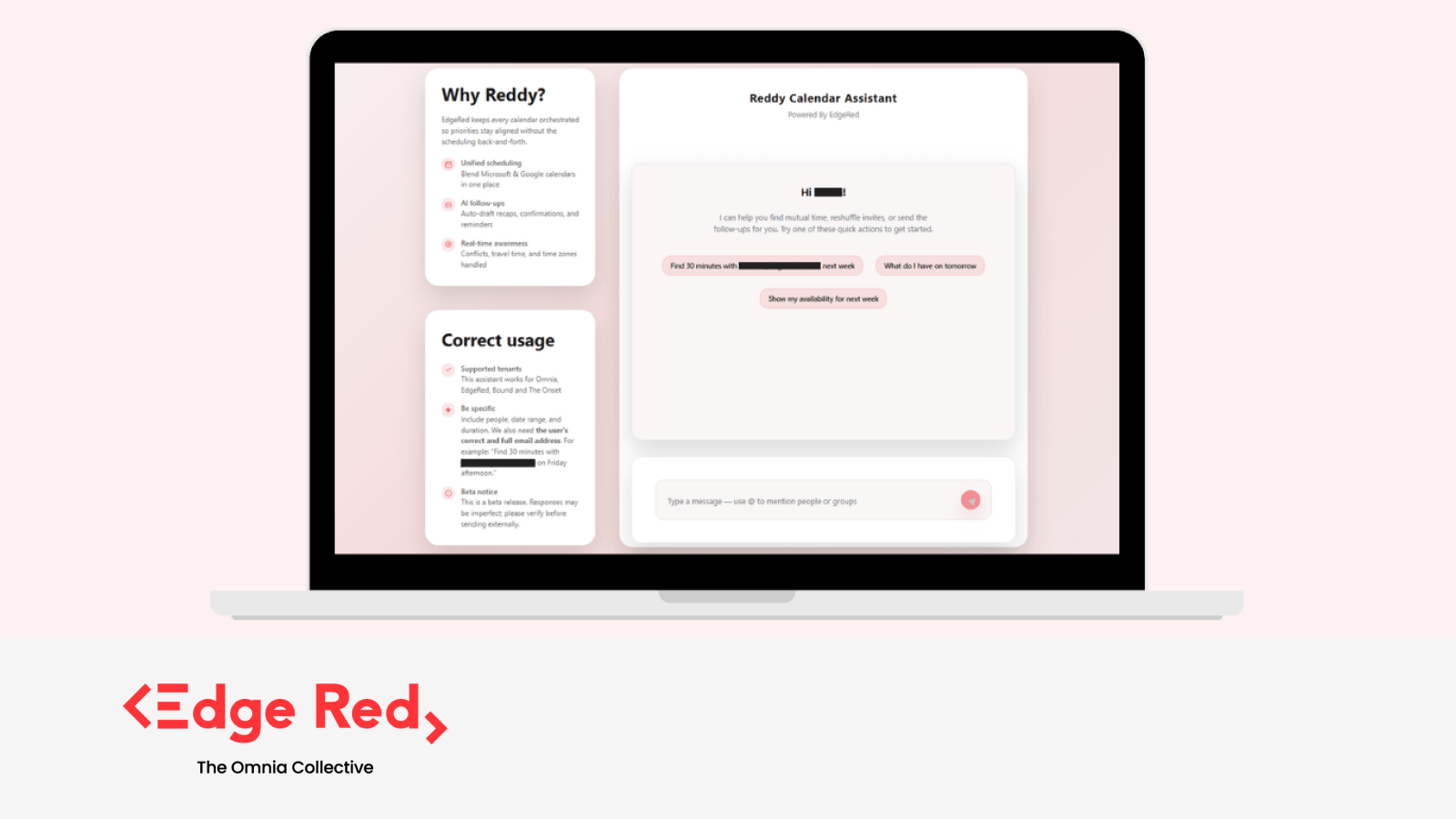
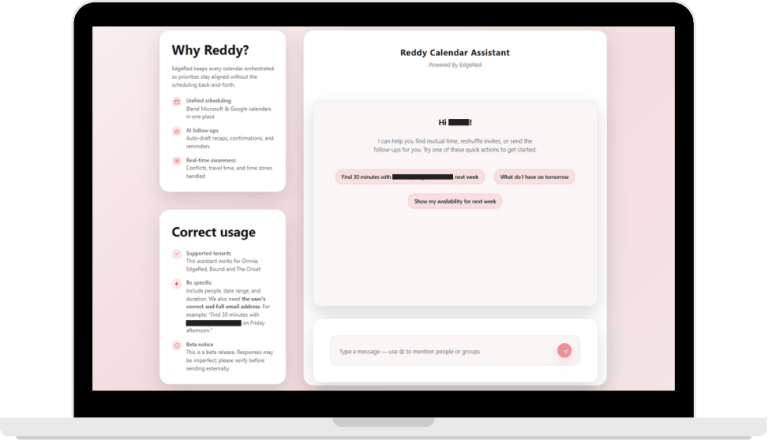
By leveraging some of the latest tech in AI, we built Reddy: a smart, natural-language calendar system. Reddy doesn’t just show you a grid; it acts as a bridge between organisations, allowing you to sync, schedule, and manage your time simply by asking.
Don’t wait for the invite. Just be Reddy.
The architecture: built for scale, safety, and trust
To solve the “cross-org” challenge, we moved beyond basic wrappers. We built a robust backend designed for the reliability a data leader expects.
1. Bridge building with MCP (Model Context Protocol)
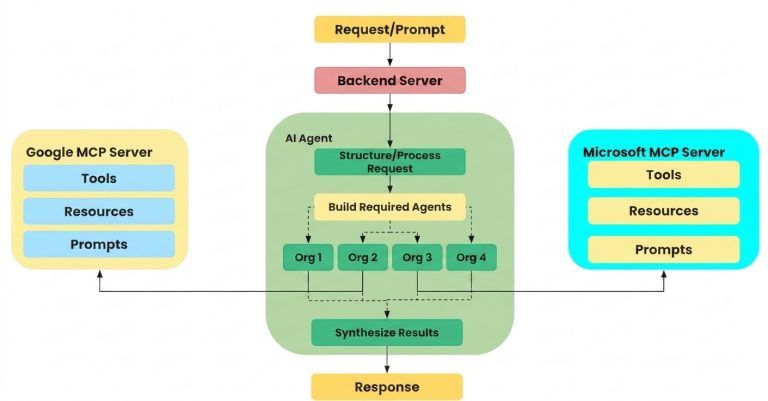
When we built Reddy, open-source tools for Google and Microsoft Calendar lacked the scalability we required. We built our own MCP Servers using Python and Starlette.
- Business Value: This allows Reddy to “plug into” existing enterprise ecosystems without requiring a total infrastructure overhaul. Moreover, it allows agents to connect for non-deterministic workflows.
2. Type-safe agentic workflows
We utilised PydanticAI as our core framework. In a production environment, “hallucinations” in a calendar are unacceptable.
- Business Value: High-fidelity execution. When Reddy says a person is free, they are actually free.
- Technical Edge: The framework enforces type safety across complex agentic workflows, ensuring that inputs and outputs remain predictable as the system scales.
3. The “guard agent”
Accessing organisational calendar data requires a “security-first” mindset. We implemented a multi-stage process to protect data integrity:
- Guarding: An initial agent and processing logic which sanitises every user prompt, guarding against prompt injection or “LLM poisoning.”
- Atomic Routing: We deploy dedicated agents for each organisation that run in parallel. This ensures that a request for “Company A” never leaks context into “Company B.” Each agent acts atomically, pulling only the information relevant to its specific server to be synthesised together with authorisation governed via OAuth.
4. Full-stack observability
For complex multi-agent and system workflows, observability is critical. We integrated Logfire for deep observability with distributed tracing.
- Business Value: Complete transparency. We can track the “why” behind every automated decision.
- Technical Edge: We monitor the entire lifecycle of a request through detailed traces, allowing for rapid debugging and performance tuning in real-time.
Business value
This product is not an internal tool to collect dust. This is a powerful product that increases efficiency through reliably and quickly querying cross-organisational calendars to increase meeting and ultimately decision velocity.
While this use case is specific for calendars, it can be done with most information that needs to be shared across organisations.
Thinking about an AI calendar assistant for your team?
If Reddy sounds like something your team could use — or if the same architecture could apply to other cross-organisation data problems you’re working through — we’re happy to talk it through. Talk to us.
This blog was written by Jack and Varun, Data Analysts @EdgeRed
About EdgeRed
EdgeRed is an Australian AI and data consultancy, part of The Omnia Collective group, with teams in Sydney and Melbourne. We build things that work in production – agentic AI, machine learning, data engineering, and Microsoft Fabric implementation. 250+ projects. 100+ clients. 100% Australian onshore team.